The first job is finding the runway, not selling a plan. Mice leave rice-grain droppings in a line along a baseboard, greasy smudge marks where a wall meets the floor, and shredded paper or insulation in a corner of…
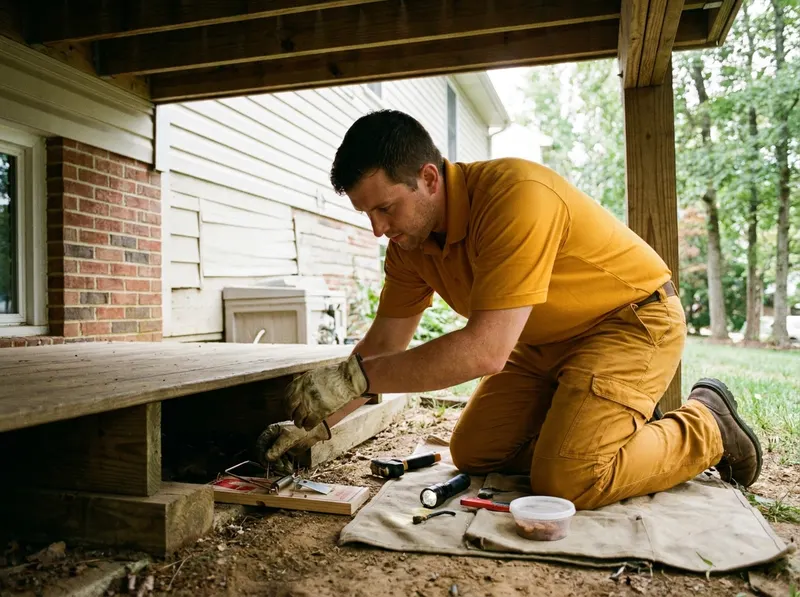
The first job is finding the runway, not selling a plan. Mice leave rice-grain droppings in a line along a baseboard, greasy smudge marks where a wall meets the floor, and shredded paper or insulation in a corner of the garage. A house mouse pushes through a gap about a quarter-inch wide — pencil width — and a Norway rat needs only about a half-inch. In Odenton that usually means the dryer vent collar, the gap around the water line under the kitchen sink, an unsealed sill plate, or the corner of a garage door where the rubber sweep has worn back. Traps go where the evidence is, and you get the list of placements so you know exactly what is in your house and where.
Housing stock changes the approach street by street. In the townhome rows of Seven Oaks and Conway Village, shared wall and attic voids let mice travel between units, so trapping is paired with sealing at your unit's own penetrations rather than blanket treatment. Newer slab-built homes in Two Rivers, Villages at Two Rivers and Chapel Grove usually give up entry at plumbing and HVAC penetrations and around the garage. Homes backing the wooded edges near Piney Orchard Nature Preserve and the Little Patuxent River corridor see fall pushes of field mice when the first cold snap hits, and properties closer to Odenton Town Center, the MARC station and the Waugh Chapel commercial strip are where Norway rats — burrowing near storm drains, sheds and mulch beds — are more likely to be the actual animal. Naming the species matters, because rat trapping uses larger traps, different placement heights and a longer bait-familiarization period than mouse work.
Here is where trapping fits and where it does not. Trapping is the right call inside an occupied home, especially with kids, dogs or cats, because every rodent is recovered and removed rather than left to die inside a wall, and the trap count tells you honestly whether activity is dropping. Trapping is slower than poison — expect days, not one afternoon — and it demands return visits, which is the trade-off you accept in exchange for no odor problem and no secondary-poisoning risk. Exterior rodenticide in tamper-resistant stations has a role for rat pressure in yards and along fence lines, and it is discussed openly when it applies. What we will not do is toss loose bait blocks into an attic or crawlspace and call it a solution, or sign you to an open-ended contract to handle a single mouse in a Patuxent Ridge kitchen.
Trapping alone is a body count, not a fix. If the entry point stays open, new mice follow the same scent trail within weeks, which is why prior DIY snap traps and store-bought bait "worked for a week." The durable version of this service is trapping plus exclusion: copper mesh and sealant at pipe penetrations, hardware cloth over crawlspace vents, a rebuilt garage door sweep, and repair of the chewed vent screen. Exclusion is quoted separately from trapping so you can see what each part costs and decide. Rentals near Fort George G. Meade with a PCS timeline get the same written scope, which is the document a landlord or property manager will actually accept. Call (667) 360-0537 and describe what you are hearing and where — ceiling, wall, or under the stove — and the visit gets scheduled around that.
Every job gets a firm, written price after a free on-site visit.
Tell us about your mouse and rat trapping job in Odenton and we'll send a clear, written quote — usually the same day.
 Kavexa Pest Defense